
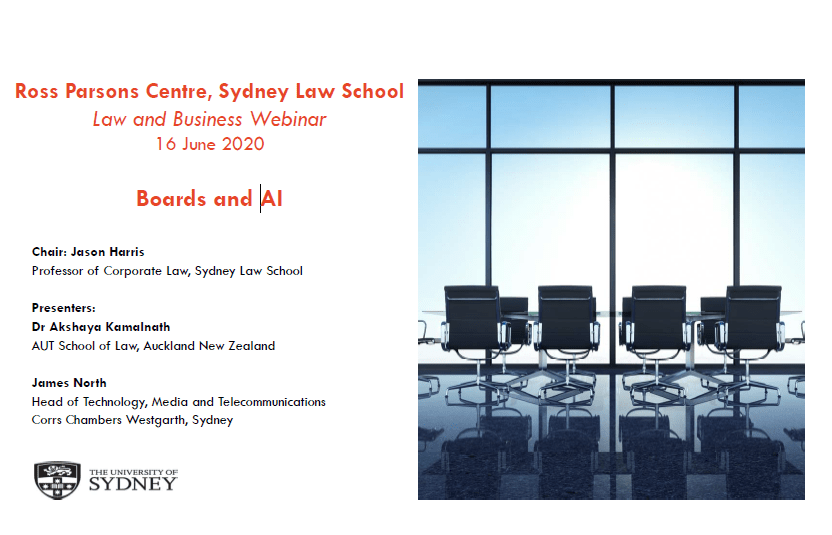
Earlier this week, I had the pleasure of attending a webinar hosted by The University of Sydney on ‘Boards and AI’. For me, having some spare time during this pandemic is a great opportunity to expand horizons and explore new areas of law. It was a fantastic webinar chaired by Jason Harris (professor of Corporate Law at Sydney Law School) discussing the use of AI in board of directors to aid decision making.
Dr Akshaya Kamalnath
The first presenter was Dr Akshaya Kamalnath of Auckland University of Technology, School of Law. You can find her profile HERE. She has recently just published a paper called “The perennial quest for board independence: artificial intelligence to the rescue?” which is available in the Albany Law Review. Dr Kamalnath firstly discussed the role of the corporate board of directors – this included accessing networks, advising and monitoring. Whatever particular roles the boards have, they all share common issues. The two that were highlighted by Dr Kamalnath are firstly, an information overload and secondly, a ‘groupthink’ approach.
With the information overload, board members are frequently faced with large quantities of information to read, process and digest before meetings. The reality is that it is not always possible to review all the information in the information pack in time. This leaves the possibility of certain pieces of information being overlooked.
The second issue of the ‘groupthink’ approach is where the members of the board are striving for a harmonious and unanimous result that it can skew the decision making process into something irrational or dysfunctional. It is essentially a “don’t rock the boat too much” mentality. Humans are also susceptible to biases which can also affect the board’s final outcome.
A solution in AI?
Dr Kamalnath suggested a variety of solutions that could help overcome the issues outlined above: increasing awareness of the issues, having diverse board members and outsourcing the board, to name a few. The focus of this webinar was whether AI software could be used.
We were guided through the use of AI software in oncology whereby the current programme in use identifies treatment options for each patient, recommends certain procedures, outlines the side effects and chances of survival. However, it has been noted that this software is not completely infallible and still makes some mistakes.
The use of AI has many perks – the programme is not susceptible to human biases, it can process vast quantities of data to produce an evaluation, and the outcome of the software can be used by board members to challenge the other members’ course of action. This would relieve some of the issues that lie with the ‘groupthink’ approach because individual members of the board may be more likely to suggest other courses of action if they can be supported by the software.
On the issue of integrating AI into corporate governance and the board of directors, however, Dr Kamalnath suggested that it is not possible yet to completely replace human board members with AI. Although the software does have benefits (as outlined above), it was suggested that boards still need flexibility which cannot be programmed into the software. Additionally, there may be areas of the decision making process where the law does not have clear-cut answers, which the AI software would not be able to account for. Thus, Dr Kamalnath concluded that whilst AI can be an incredibly useful tool for boards, it cannot completely replace human directors just yet.
James North
The second speaker was James North. James is the head of Technology, Media and Telecommunications (TMT) at Corrs Chambers Westgarth in Sydney. You can find out more about James and his practice HERE. James highlighted that many industries are using a ‘narrow AI’ as opposed to a general AI, meaning that the software is built for a specific function. For example, he discussed the use of AI in banking which assists in credit transactions for clients. Again, James agreed with Dr Kamalnath that, at the moment, AI lacks the ability to make the judgments that a human director can.
He emphasised the legal risks of use AI too, particularly when it comes to the high standard of fiduciary duties that the board members owe to shareholders. In many jurisdictions, board members will have defences of good faith, reasonable judgment and other similar tools. However, this generally means that the board members cannot accept the result of the AI software at face value – it would still need to be reviewed and justified. This then runs into the problem of having to understand and explain how the software arrived at the result that it did, but this is essentially trying to work out trade secrets since the software is the property of the manufacturer. Indeed, James highlighted that there has always been tension between intellectual property law and competition law. Additionally, there is also the risk of the software being hacked and producing biased results.
Takeaway
I really enjoyed this high-level webinar on a topic that is completely new to me. Unfortunately, I didn’t have the chance to take the Legal Technology module on offer at my university so I really enjoyed learning about the future use of AI in the legal industry, and specifically for boards. Although I have experience with AI software for document review and management (for example, BrainSpace at CMS), it was interesting to hear how AI could be used for helping boards make top-level decisions. Whilst human directors cannot yet be completely replaced by AI just yet (a relief to some people, I’m sure!) it will most certainty to worth keeping an eye on this in the future and see how AI develops for its potential emergence for boards!
I’m grateful to have been able to attend this webinar and I’d really encourage any of my connections to use any spare time they may have right now to take advantage of any webinars on offer! It’s a great opportunity to learn new things and grow our network!
 seethrough.law.blog